Is Aviator Legal in India: Can You Play It Legally, Is Aviator Considered Gambling and Is the Game Banned in India?

Last updated: August 2026. This legal status has been checked against the text of the Promotion and Regulation of Online Gaming Act, 2025, MeitY/PIB materials on the 2026 Rules coming into force, Supreme Court of India rulings, and Income Tax Department data.
Short answer: is Aviator legal in India right now

1. Real-money play — no, it’s not legal. The Promotion and Regulation of Online Gaming Act, 2025 (PROGA) has applied across the whole of India since 1 May 2026 and bans all online real-money games. Aviator, when played for stakes, meets the criteria of an online money game under the 2026 Rules.
2. Legally speaking, it’s gambling. The old “game of skill vs game of chance” argument no longer matters for Aviator: PROGA scraps that distinction entirely, and on 27 May 2026 the Supreme Court ruled that what counts is simply staking money on an uncertain future outcome.
3. The game itself, as software, isn’t “banned” — it’s the paid versions, advertising and payments that are prohibited. A demo (free-to-play) mode with no entry fee and no withdrawal option doesn’t meet the criteria of an online money game. But deposits, stakes, withdrawals, advertising for the platform, and processing its payments are all off-limits.
PROGA’s constitutionality is currently being challenged before the Supreme Court, and there’s no final ruling on these petitions as of this update. Until a decision comes down, the law applies in full.
What’s changed: the Promotion and Regulation of Online Gaming Act, 2025

Before 2025, online gambling in India was regulated in a fragmented way: gambling fell under state jurisdiction, the colonial-era Public Gambling Act, 1867 and various local laws applied, and courts drew a line between games of skill and games of chance. Out of that arrangement came the old “grey area, it depends on the state” line you’ll still spot in outdated articles. That’s no longer accurate.
Key dates and current status
- 20 August 2025 — the bill was introduced and passed by the Lok Sabha.
- 21 August 2025 — passed by the Rajya Sabha.
- 22 August 2025 — signed by the President of India; the law was numbered Act No. 32 of 2025.
- 22 September 2025 — GST on online money games and other specified actionable claims raised to 40%.
- 22 April 2026 — the Union Government announced the law’s commencement date; the Promotion and Regulation of Online Gaming Rules, 2026 were published in the Gazette of India.
- 1 May 2026 — PROGA and the 2026 Rules came into force.
- 27 May 2026 — the Supreme Court (bench of Justices J. B. Pardiwala and R. Mahadevan) ruled on related batches of cases: online gaming taxation and the legality of state-level bans.
What exactly the law prohibits: three tiers
- Promoting legitimate segments. Sections 3 and 4 develop e-sports and non-commercial social games.
- A blanket ban. Section 5 prohibits offering and facilitating all online real-money games, Section 6 bans advertising them, and Section 7 bans processing payments for them. The law explicitly removes the old judicial distinction between games of skill and games of chance.
- A single national framework. The law standardises enforcement across states and overrides any conflicting state rules. Banks and other financial institutions are barred from processing such platforms’ payments, and authorities have been given powers to block illegal services.
The advertising ban is written broadly: it covers anyone who creates, facilitates, incites, or otherwise takes part in advertising that directly or indirectly promotes online money games.
Penalties under PROGA
| Violation | Who it applies to | Imprisonment | Fine |
|---|---|---|---|
| Offering or facilitating a banned online money game (Sec. 5) | Operator, any person offering or facilitating the service | Up to 3 years | Up to ₹1 crore |
| Advertising and promoting online money games (Sec. 6) | Advertiser, platform, distributor | Up to 2 years | Up to ₹50 lakh |
| Processing prohibited financial transactions (Sec. 7) | Bank, financial institution, or any other party facilitating payments | Up to 3 years | Up to ₹1 crore |
| Repeat offence under Section 5 or 7 | Operator, payment facilitator | 3 to 5 years | ₹1 crore to ₹2 crore |
| Repeat offence under Section 6 (advertising) | Advertiser, platform | 2 to 3 years | ₹50 lakh to ₹1 crore |
| Failing to comply with regulator directions (Sec. 12) | The person to whom the direction is addressed | — | Civil penalty up to ₹10 lakh, suspension or cancellation of registration, ban on offering, facilitating or promoting games |
Offences under Sections 5 and 7 are classified under Section 10 as cognizable and non-bailable — meaning arrest can happen without a warrant, and bail isn’t granted by default.
Section 14 allows blocking of any information linked to an online money gaming service, and is worded to override Section 69A of the Information Technology Act, 2000. For comparison, under the previous Section 69A mechanism, roughly 1,524 blocking orders were issued against betting and gambling sites and apps between 2022 and June 2025.
The 2026 Rules and the Online Gaming Authority of India
The Rules were drafted by the Ministry of Electronics and Information Technology (MeitY) and came into force alongside the law. They:
- set out a mechanism for determining whether a game is an online money game (and therefore banned) or a permitted social game or e-sport;
- establish the Online Gaming Authority of India (OGAI) as a single digital regulator;
- introduce registration for e-sports and certain categories of social games;
- mandate user safety features, a complaint-handling mechanism, and transparency requirements;
- set out how civil penalties under Section 12 are imposed, plus an appeal mechanism.
OGAI sits under MeitY: it’s headed by an Additional Secretary of MeitY, with representatives from the Ministry of Home Affairs, the Ministry of Finance, the Ministry of Information and Broadcasting, the Ministry of Sports, and the Ministry of Law and Justice. The regulator’s functions include maintaining and publishing a list of online money games, handling complaints, issuing directions and codes of practice, hearing appeals, and coordinating with financial institutions and law enforcement.
Classification test (Rule 9). The Rules list objective factors: payment of a fee, deposit or stake; expectation of a monetary or other winning; the revenue model structure; and whether rewards or in-game assets can be transferred, cashed out, or monetised outside the game. A determination is made, as far as practically possible, within 90 days and recorded in a determination order. A registration certificate for legitimate categories is issued digitally, valid for up to 10 years. An online money game cannot be recognised or registered as an e-sport under the National Sports Governance Act, 2025.
Is Aviator considered gambling in India
How Aviator works
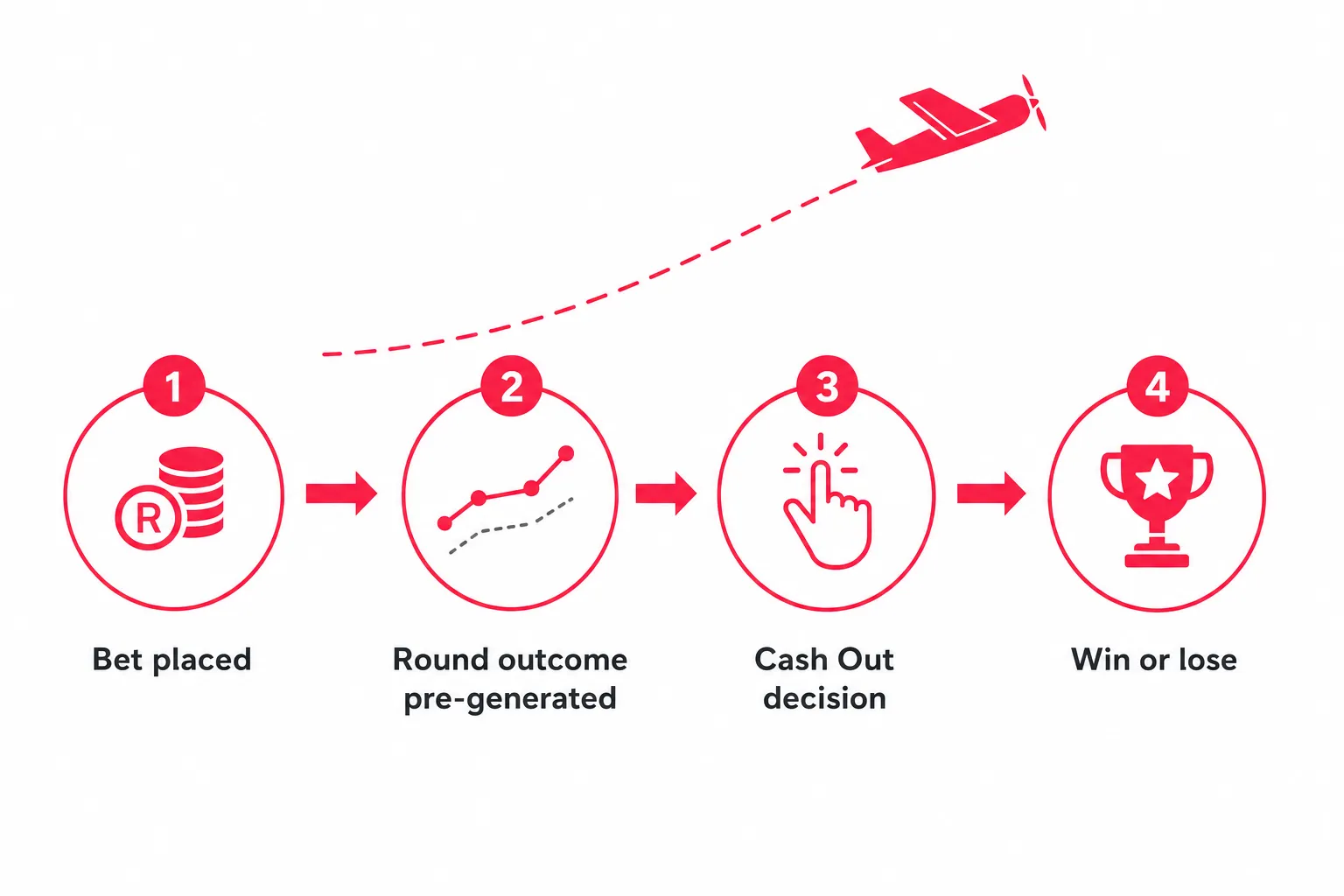
Aviator is a crash game developed by SPRIBE (SPRIBE OÜ), first launched in early 2019. Each round works like this: a player places a bet before the flight starts, a multiplier begins at 1× and climbs, and the goal is to hit Cash Out before the plane flies off the screen. If you don’t Cash Out before the crash, your stake is lost. The payout equals your stake multiplied by the multiplier at the moment you cashed out.
The developer’s stated RTP is 97% (a theoretical house edge of 3%). RTP is a long-term mathematical figure calculated across a large volume of bets — it’s not a promise that you’ll get back 97% in any single session. A short run of rounds can swing well above or below that figure. You can read more about how this figure is calculated on our dedicated Aviator RTP page.
The game uses a Provably Fair mechanism: the multiplier at which the plane will crash is generated before the round starts, and once the round ends, the result can be verified through the bet history (My Bets) using a built-in verification tool. In other words, the mechanism confirms the fairness of a round that’s already been played — it doesn’t let you predict the outcome in advance. For a deeper technical breakdown, see our page on how the Aviator algorithm works.
A note on parameters. There’s no single public maximum multiplier or set of universal limits for the game — minimum and maximum bets, plus the maximum payout, are set by each individual operator. Always check these figures in the game’s own interface and the platform’s rules, rather than relying on third-party reviews.
Why the “it’s a game of skill” argument no longer holds up
Technically, a round’s outcome is generated before it even begins, and doesn’t depend on the size of the bet, the number of players, or when other players cash out. Every round is mathematically independent from the last: a run of low multipliers doesn’t raise the odds of a high one coming next. The only decision a player makes is when to Cash Out, and that choice doesn’t change a crash point that’s already been generated.
But that technical breakdown is now beside the point legally. The current position is this:
- PROGA explicitly scraps the long-standing judicial distinction between games of skill and games of chance — both categories are now banned if real money is staked.
- On 27 May 2026, the Supreme Court (bench of Justices J. B. Pardiwala and R. Mahadevan) ruled that online gaming platforms, fantasy sports and casinos where players stake money or a money equivalent on an uncertain outcome all amount to “betting and gambling” — regardless of whether skill or chance is involved. The deciding factor isn’t skill; it’s the act of staking money on an uncertain future outcome.
- Under Rule 9’s criteria, the paid version of Aviator meets the definition of an online money game: there’s a stake, an expectation of a monetary win, and the ability to withdraw funds.
Bottom line: the “Aviator is a game of skill, so it’s allowed” argument carries no legal weight in India after 2025–2026.
Is Aviator banned in India: the game itself, or just the paid version
The law doesn’t ban a specific piece of software — it bans a business model. What’s prohibited includes:
- offering the game for real money to Indian users, including from servers based outside India;
- advertising and any promotion of such games — direct or indirect;
- processing payments to and from such services;
- hosting and distributing related information (Section 14 allows this to be blocked, overriding Section 69A of the IT Act).
Modes that involve no entry fee, no stake, and no way to withdraw funds — in other words, demo and social formats — don’t fall under the definition of an online money game.
Why sites offering Aviator still load in India
Accessibility isn’t proof of legality. Offshore platforms sit physically outside India’s jurisdiction, which makes prosecuting their operators difficult, so enforcement relies mainly on two tools: blocking domains and apps, and cutting off payments through the banking system. Platforms respond by switching domains and setting up “mirrors”, which creates the illusion for users that no ban actually exists.
Available doesn’t mean legal. A site that still loads, an app that still works, or an advert you still see doesn’t change the legal status: online real-money games remain banned across the whole of India.
A VPN doesn’t fix this. Changing your IP address doesn’t take you outside Indian law, and it doesn’t make banned activity legal. On top of that, almost every platform lists bypassing geo-restrictions as grounds for closing accounts and voiding winnings.
What actually happens to a player, as opposed to an operator
Here’s a breakdown of the personal consequences — not the abstract crore-level fines aimed at operators, but what actually affects an individual user.
| Scenario | Who’s liable | Legal basis | Practical impact on the player |
|---|---|---|---|
| Playing Aviator for real money on an offshore site | Primarily the operator: offering, advertising and processing payments are criminalised | PROGA, Sections 5, 6, 7; penalties up to 3 years and/or up to ₹1 crore; Sections 5 and 7 are cognizable and non-bailable (Sec. 10) | There’s no separate offence in PROGA for “taking part” in the game, but the platform’s activity is illegal: the player has no legal protection and no lawful way to recover funds |
| Located in a state with its own ban (e.g. Tamil Nadu) | Liability can also fall on the player directly | Tamil Nadu state law: up to 3 months’ imprisonment or a fine of up to ₹5,000, or both | Possible liability under state rules on top of the federal ban |
| Depositing or withdrawing via bank, UPI, or card | Banks and payment providers must refuse service; Section 7 is aimed at banks, financial institutions and anyone processing such payments | PROGA, Sections 7 and 9(3) | Declined transactions, possible frozen funds, stuck withdrawals, bank queries about the transaction |
| The site is blocked or switches domains | Operator; blocking is enforced by directive | PROGA, Section 14 (overrides Section 69A IT Act) | Loss of access to account and balance. The complaint mechanism (operator → OGAI → MeitY Secretary, each stage up to 30 days) applies to legitimate game categories, not to illegal platforms |
| Winnings won and withdrawn | Player | Section 115BBJ — 30% on net winnings; 30% TDS on withdrawal | A tax obligation and the risk of tax authority queries remain, regardless of whether the platform was legal |
What this means in practice:
- The law’s main force is aimed at operators, advertisers and payment infrastructure, not at ordinary users. But that doesn’t mean zero risk.
- Real losses for players are usually financial rather than criminal: a declined payment, a frozen withdrawal, a domain that disappears, a balance you can never get back.
- A player’s own liability can arise at state level — for example, under Tamil Nadu’s law.
- Tax obligations arise from the fact of earning income and don’t depend on whether the platform was legal.
What you can legally do
- Demo and free-to-play modes. If there’s no entry fee, no stake, and no way to cash out a result, the online money game criteria under Rule 9 aren’t met. This applies to free versions of crash games too, including SPRIBE’s official Aviator demo.
- E-sports. The law directly supports this category (Sections 3 and 4) and provides for registration. That said, a paid online money game can’t be registered as an e-sport under the National Sports Governance Act, 2025.
- Certain categories of social games, registered as set out in the 2026 Rules.
- The offline segment. Land-based casinos, horse racing, and lotteries remain under state jurisdiction and continue operating within their own frameworks — for example, licensed offline casinos in Goa. This has no bearing on online Aviator: online money games are banned in Goa too.
Warning. Any “legal alternative” that involves depositing and withdrawing real money is still a banned online money game, no matter what it’s called — “social”, “skill-based”, “tournament”, or “crypto”.
States: how federal rules and state laws fit together
The old “legality depends on the state” line was accurate before 2026, and it’s misleading now. Here’s how it actually works:
- PROGA applies across the whole of India. A state can’t permit what a central law prohibits.
- States can add stricter rules, including liability for the player themselves.
- On 27 May 2026, the Supreme Court confirmed states’ authority: Tamil Nadu and Karnataka’s laws banning online real-money games were declared constitutional, the Madras and Karnataka High Court rulings were overturned, and the activity was classed as res extra commercium, meaning it isn’t protected under Article 19(1)(g) of the Constitution.
- Offline gambling is a separate matter regulated by states, and has no bearing on online Aviator.
| Jurisdiction | Online real-money games | Player’s own liability | Note |
|---|---|---|---|
| All of India (federal level) | Banned (PROGA, Sec. 5) | No direct player-liability rule in PROGA | Ban applies regardless of which state a person lives in |
| Tamil Nadu | Banned | Up to 3 months’ imprisonment or a fine of up to ₹5,000, or both | State law confirmed constitutional by the Supreme Court |
| Karnataka | Banned | Under federal and state law | State law confirmed constitutional; Karnataka High Court ruling overturned |
| Telangana | Banned | Under federal and state law | The first Indian state to ban online real-money games |
| Sikkim | Banned by federal law | Under federal law | The state historically followed a licensing and regulation approach |
| Goa | Banned | Under federal law | The state’s licensed offline casinos don’t override the online ban |
| Other states and union territories | Banned | Under federal law; states may impose stricter rules | States can tighten the ban, but not loosen it |
Taxes on Aviator winnings in India
A common misconception is that an illegal platform somehow cancels out tax obligations — it doesn’t.
- Income tax. Income from online games is taxed under Section 115BBJ of the Income Tax Act at a flat 30% on net winnings. This rule came in under the Finance Act 2023 and applies from assessment year 2024–25. Standard deductions and the basic tax-free threshold don’t apply to this income.
- TDS (tax deducted at source). Deducted at 30% — on withdrawal, or at the end of the financial year if no withdrawal was made. There’s no minimum threshold below which this deduction doesn’t apply. This rule used to sit under Section 194BA; following tax law reforms, the section numbering may have changed — check the current version on incometaxindia.gov.in.
- GST. Since 22 September 2025, the rate on specified actionable claims — betting, casinos, gambling, horse racing, lotteries and online money games — has risen from 28% to 40%. This is a tax on the operator, not the player, but it largely explains the market’s economic retreat. The constitutionality of the previous 28% rate on the full value of bets was confirmed by the Supreme Court on 27 May 2026, including retrospectively.
The practical takeaway: if you withdraw winnings, you’re obligated to declare that income — and an offshore platform typically won’t deduct any TDS on your behalf.
Risks of offshore sites and fake Aviator clones

Legal status isn’t the only concern. For people already playing, the operational risks are often more immediate.
- No consumer protection. The complaint mechanism (operator → OGAI → MeitY Secretary) only works for legitimate, registered game categories. There’s no way to complain to a regulator about a banned platform refusing a withdrawal.
- Payment problems. Banks and payment providers are barred from servicing these platforms: transactions get declined, and funds can get stuck between the platform’s wallet and your bank account.
- Blocks and “mirror” domains. A domain can vanish at any moment, taking your account and balance access with it. Getting it back through a new domain depends entirely on the operator’s goodwill.
- Fake clones. Alongside SPRIBE’s genuine product, unofficial copies exist with similar visuals but no Provably Fair mechanism and no stated RTP. There’s no way to verify fairness on a round in one of these copies. You can find out more about verifying fairness on our page about whether Aviator is fair or rigged.
- Predictor and hack apps. The crash multiplier is generated before the round starts, and every round is independent of the last, so no external app can predict it. There’s no verified accuracy behind these tools, and the developer doesn’t endorse any of them. Industry sources have repeatedly warned about scams built around predictor services — see our detailed review of whether Aviator predictors are real or fake.
Warning signs to stop and reconsider:
- a platform or service promises a “guaranteed signal”, a “hacked algorithm”, or a fixed win rate;
- you’re asked to install an APK outside official app stores;
- you’re asked for an extra deposit, a “tax payment”, or “withdrawal insurance” before a payout;
- the domain recently changed and the old one no longer works;
- there’s no way to verify a completed round through Provably Fair;
- support refuses to keep a written record and pushes the conversation to a messaging app instead.
What’s next: the constitutional challenge to PROGA in the Supreme Court
It’s important not to confuse two separate cases here — this is where most of the misinformation comes from.
The first case — already decided (27 May 2026). A bench of Justices J. B. Pardiwala and R. Mahadevan ruled that staking money or a money equivalent on an uncertain outcome amounts to “betting and gambling” regardless of skill or chance. The Karnataka High Court’s ruling from 11 May 2023 was overturned, and the 28% GST rate on the full value of bets was confirmed as constitutional, including retrospectively. The same day, the Madras and Karnataka High Court rulings on state laws were also overturned: Tamil Nadu and Karnataka’s laws were declared constitutional, the activity was classed as res extra commercium, and states’ authority to regulate, restrict, or fully ban online money games was upheld.
The second case — not yet decided. Petitions challenging PROGA’s constitutionality are being heard by a three-judge bench: Chief Justice Surya Kant, and Justices Joymalya Bagchi and V. M. Pancholi. The court has instructed the parties to complete the exchange of pleadings before final hearings. Questions raised include whether handing government such broad powers under Sections 3, 4 and 5 amounts to excessive delegation, and whether the blanket ban under Section 5 is a disproportionate restriction on the right to choice, autonomy, and livelihood under Article 21 of the Constitution. The outcome will determine whether the ban — covering both games of skill and games of chance — survives as is.
Timeline
- August 2025 — PROGA passed and signed into law.
- 22 September 2025 — GST on online money games raised to 40%.
- 22 April 2026 — 2026 Rules published and commencement date announced.
- 1 May 2026 — PROGA and the Rules came into force; OGAI established.
- 27 May 2026 — Supreme Court rulings on the tax cases and state laws.
- Current status — the constitutional challenge to PROGA is still pending, with no final ruling.
Three possible outcomes and what each means for players
- The ban survives — nothing changes: online money games remain banned.
- The ban is struck down entirely — a new regulatory model would be needed; this wouldn’t automatically legalise offshore platforms, since states’ authority has been confirmed separately.
- The ban is partially amended — most likely through narrowing specific provisions or introducing a licensing requirement; the details would depend on the wording of the ruling.
Until a ruling is handed down, the law remains in force, and any headline suggesting “the ban is about to be lifted” is a prediction, not the current legal status.
FAQ
Is Aviator legal in India in 2026?
Real-money play — no. Since 1 May 2026, PROGA has banned all online real-money games across India. Free demo modes don’t fall under the definition of an online money game.
Is Aviator a game of chance or a game of skill?
Legally, it’s gambling. PROGA removes the distinction between games of skill and games of chance, and on 27 May 2026 the Supreme Court ruled that what matters is simply the act of staking money on an uncertain outcome.
Can you go to jail for playing Aviator?
PROGA doesn’t have a separate offence for “taking part” in the game — the penalties target operators, advertisers, and those processing payments. But individual state laws may hold players liable too: in Tamil Nadu, for example, that’s up to 3 months’ imprisonment or a fine of up to ₹5,000. See the personal-consequences table above for details.
Is the demo mode of Aviator legal?
A mode with no entry fee, no stake, and no way to withdraw funds doesn’t meet the online money game criteria under the 2026 Rules. That said, advertising that uses a demo to promote the paid version is still banned.
Is Aviator banned in Goa and Sikkim?
Yes, for real-money play — the ban is federal and applies in every state. Goa’s licensed offline casinos are regulated separately under state law and don’t affect the status of online games.
Why do Aviator sites still load?
Because offshore operators sit outside Indian jurisdiction, and enforcement relies on blocking domains and cutting off payments. A site loading doesn’t mean it’s legal.
Do you have to pay tax on Aviator winnings?
Yes. Income from online games is taxed at 30% on net winnings (Section 115BBJ), and TDS is deducted at 30% with no minimum threshold. This tax obligation applies regardless of whether the platform was legal.
Do predictor apps for Aviator actually work?
No. The crash multiplier is generated before the round starts, and each round is independent of the previous one. There’s no verified accuracy behind these tools, and the developer doesn’t endorse them.
What’s Aviator’s RTP?
The developer states 97%. This is a long-term theoretical figure calculated over a large volume of bets, not a guaranteed result for any single session; bet limits and maximum payouts are additionally set by each operator.
Could the Supreme Court overturn the ban?
Petitions against PROGA are before a three-judge bench, and there’s no ruling yet. Until one is issued, the law applies in full.
Does a VPN help?
No. Changing your IP address doesn’t change the applicable law and doesn’t legalise banned activity — and it’s usually grounds for a platform to freeze your account and void your winnings.
What happens to money stuck on an offshore site?
OGAI’s complaint mechanism doesn’t cover illegal platforms, so there’s no lawful way to force a refund. Getting your money back depends entirely on the operator.
Responsible gaming and disclaimer
This material is for informational purposes only, intended for people over 18, and does not constitute legal or tax advice. It also isn’t an offer, invitation, or promotion of online real-money games.
The legal status may change — including as a result of the pending petitions against PROGA before the Supreme Court. Before making any decisions, check current rules against original sources and, where necessary, consult a qualified legal or tax professional.
Signs that a game has stopped being entertainment include: betting with borrowed money, chasing losses, hiding spending from loved ones, worsening sleep and productivity, and being unable to stop after a planned limit. The fast pace of short rounds typical of crash games can make it even harder to stop. If any of this sounds familiar, consider reaching out to a therapist, a specialist counselling service, or a mental health support helpline. If you’d like general guidance on keeping play under control, our page on responsible Aviator gambling covers this in more detail.