Is Aviator Fair or Rigged: Can the Game Be Manipulated, Does the Casino Control the Results and Is Aviator Legit?
Last updated: 30 August 2026
If you’re trying to work out whether Aviator is rigged, chances are you don’t need another rules guide or a bag of “strategies.” You need a straight answer — and a way to check it yourself. Below we give you both, plus something specific to South Africa: how legit the game actually is from a legal standpoint.
The short answer: is Aviator rigged?
Aviator by SPRIBE (first launched in early 2019) runs on a provably fair system: the multiplier at which the plane crashes is generated before the round starts, and you can verify it yourself once the round ends. The operator can’t “drop the plane” the moment you place a big bet. But that doesn’t mean the game is profitable — the stated RTP is 97%, meaning a 3% house edge is baked into the maths.
- The round outcome is fixed in advance and can be verified by you afterwards, using the hash and revealed seeds.
- The operator cannot change a specific round’s crash point. Your bet size, and the actions and cashouts of other players, play no part in the multiplier calculation.
- “Fair” doesn’t mean “profitable.” With a 97% RTP, out of every R100 wagered over the long run, R97 goes back to players and R3 stays with the house.
- The real risk isn’t rigging — it’s fake Aviator clones, paid “predictors,” Telegram channels selling “signals,” and playing with an operator that isn’t licensed in South Africa.
- There’s a second “legit” question specific to South Africa — the legal status of casino-style games offered through bookmakers. Following the Supreme Court of Appeal’s ruling on 21 October 2025, this remains a dispute between the regulator and the industry.
How Aviator actually determines the crash point

Server seed and the first three players’ seeds
The crash point isn’t a decision the server makes in real time, and it isn’t a reaction to your actions. The multiplier is generated before the round begins, from a combination of inputs:
- a server seed created by SPRIBE’s game backend (not by the casino’s front-end);
- client seeds from the first three players to place a bet in that round;
- a hash function that combines these values into a final number.
The key detail: no single party controls all the inputs. The server publishes the hash of its seed before it ever sees the client seeds, and players don’t see the server seed until the round is over.
Hash commitment before the round, reveal afterwards
The system works like a sealed envelope. The server publishes the hash of its seed in advance — this is a cryptographic commitment: the seed can’t be changed afterwards, because a new seed would produce a different hash. Once the round ends, the seed is revealed, and anyone can recalculate the hash to confirm nothing was swapped.
Two different functions from the SHA family are used in the verification: the hash of the next server seed is shown as a SHA-256 commitment before the round, while a completed round is recalculated as a SHA-512 hash from the revealed server seed and the client seeds. The exact order and format of the data are shown in the Provably Fair panel inside the game at your operator — always work from that when verifying.
Two practical takeaways follow from this mechanic:
- Rounds are independent. Your balance, bet size, win history and losing streak play no part in the calculation. A run of low multipliers doesn’t “owe” you a payout in the next round.
- Independent auditing exists. SPRIBE publishes game and RNG certificates from independent testing labs for regulated markets, including a Certificate of Suitability for South Africa. A certificate applies to a specific jurisdiction and game version — not “everywhere at once.”
What provably fair proves — and what it doesn’t
Important limitation. Provably fair proves exactly one thing: the round’s result was determined before bets were accepted and wasn’t changed after the round started. It does not prove the game is profitable, it does not cancel out the operator’s 3% edge, and it does not let you predict the next round. Losing on a fair round is normal — not a sign of manipulation. All of this applies to the official SPRIBE Aviator integration, not to unofficial copies of the game.
Check your round in 3 minutes — and what to do if the hash doesn’t match
Step 0. Confirm the operator is licensed in South Africa. Look for the licence number and the name of the provincial licensing authority in the site’s footer, then check the operator against the Verified Operators list on the National Gambling Board’s site (ngb.org.za). If the operator isn’t listed there, whether the round was fair is a secondary concern — you’d have no way to enforce anything.
Step 1. Open the round history. The multiplier history sits near the top of the screen, and a detailed list of your bets is under My Bets. Next to the relevant round you’ll see a verify icon (labelled Provably Fair) — tap it.
Step 2. Copy the round data. You’ll need: the server seed revealed after the round, the client seeds from the first three players, the round number, and the server seed hash published before the round.
Step 3. Calculate the hash using an outside tool. Open any public online SHA-256/SHA-512 calculator and enter the data exactly in the order and format shown in the verification panel — extra spaces or separators will break the result.
Step 4. Compare the two values. First: does the hash generated from the revealed server seed match the hash published before the round? Second: does the multiplier you calculated match what’s shown in the round history?
| Verification result | What it means | What to do |
|---|---|---|
| Hash and multiplier match | The round wasn’t altered after it started | Nothing to worry about with this round |
| Server seed hash doesn’t match | The round data doesn’t match the published commitment | Take screenshots and move to escalation |
| Multiplier doesn’t add up, hash matches | Usually an error in the order or format of the data | Redo the calculation exactly per the panel’s instructions; if the mismatch persists, escalate |
| Provably Fair panel is missing or won’t open | The round can’t be verified | Ask support for an explanation; a lack of verification is a strong reason to avoid this lobby |
| Seeds aren’t revealed after the round | The system is claimed but doesn’t actually work | Red flag: without seed reveal, verification is impossible |
| The info panel states an RTP other than 97% | The official SPRIBE product is publicly stated to run at 97% RTP | Check with support and confirm you’re playing the official integration, not a copy |
Escalating a complaint if the check doesn’t add up
- Operator support. Describe the problem in writing and attach: the round ID, date and time in SAST, a screenshot of the history, the server and client seeds, the published hash, and the bet amount. Ask for a written response.
- Provincial licensing authority. File your complaint with whichever regulator issued the operator’s licence — it’s listed in the site’s footer (for example, the Western Cape Gambling and Racing Board, the Gauteng Gambling Board, or the Mpumalanga Economic Regulator). Attach your correspondence with the operator.
- National Gambling Board. Inform the national regulator if the provincial level doesn’t resolve the issue, or if the operator isn’t among the verified ones.
A template you can copy and fill in:
Account: [number/email]. Round: [ID], [date and time SAST]. Bet: [amount in rand]. Server seed hash published before the round: [value]. Server seed revealed: [value]. Hash I calculated: [value]. Discrepancy: [description]. I request a written explanation and the results of your internal review of this round. Screenshots attached.
This verification confirms the correctness of a round that has already finished. It doesn’t predict future rounds and doesn’t offset the house edge.
What the casino can and can’t change
Most of the “I’ve been scammed” feeling comes from mixing up two very different things: rigging a round’s outcome and setting the conditions around the game. The first isn’t something the operator can do; the second, absolutely.
| The operator cannot | The operator can (legally, but it affects your result) |
|---|---|
| Change a specific round’s crash point after the result is generated | Decide whether the game appears in their lobby and app |
| Create a “personalised” round outcome for a specific player | Set minimum and maximum bet limits |
| Crash the multiplier in response to your big bet | Set a payout ceiling per bet (spelled out in the operator’s rules) |
| Reverse the result of a round that’s already played out | Enable or disable demo mode |
| Change the outcome based on your balance or losing streak | Decide whether Aviator counts toward bonus wagering, and at what rate |
| Fake a revealed seed so it matches an old hash | Set account limits, require FICA verification, and decide withdrawal methods and timeframes |
One separate point worth mentioning: lag. If there’s a noticeable delay between tapping Cash Out and it actually registering, that’s a connection or client-side issue — the crash point has already been determined by that stage. The game rules cover two technical scenarios separately: if your connection drops while you have an active bet, an automatic Cash Out is applied at the current multiplier; if there’s a software or hardware fault, affected bets and payouts are voided and stakes are refunded. If your case was handled differently, record the round and contact support — handling cashouts correctly is the operator’s responsibility.
RTP 97% and a 3% house edge: what it actually costs you in rand
Aviator’s stated RTP is 97%: over the long run, out of every R100 wagered, roughly R97 comes back to players and R3 stays with the house. This is a long-term theoretical figure, not a promise of getting 97% back in any single session. The official SPRIBE product is publicly stated to run at a uniform 97% RTP, and there are no confirmed operator configurations with a different figure; what can differ between platforms are bet limits and payout ceilings, not the game’s underlying maths.
Your rough chance of reaching a given multiplier follows the formula “RTP / multiplier.” The figures below are reference points from an idealised model, not a guaranteed frequency:
| Target multiplier | Approximate chance of reaching it | Approximate chance of losing 10 rounds in a row at this target |
|---|---|---|
| 1.20x | ~81% | negligible |
| 1.50x | ~65% | about 1 in 30,000 runs |
| 2.00x | ~49% | about 1 in 750 runs |
| 5.00x | ~19% | about 1 in 9 |
| 10.00x | ~10% | about 1 in 3 |
| 100.00x | ~1% | practically inevitable |
The same maths means a portion of rounds will end in an almost instant crash near 1.00x. That’s an expected feature of a model with a built-in house edge, not a “punishment” aimed at you.
Expected losses at a 3% house edge:
| Bet per round | 100 rounds | 500 rounds | 1,000 rounds |
|---|---|---|---|
| R1 | ~R3 | ~R15 | ~R30 |
| R5 | ~R15 | ~R75 | ~R150 |
| R10 | ~R30 | ~R150 | ~R300 |
These are averages over a long run — any single session’s result can swing well above or below them.
A losing streak isn’t proof of rigging. At a 5x target, ten losing rounds in a row happen roughly once in nine attempts; at 10x, it’s roughly once in three. If you’re playing hundreds of rounds a week, streaks like this are bound to happen.
Choosing a target multiplier changes your risk profile, not the underlying maths: a low target means frequent smaller cashouts, a high target means rare but large ones. Neither approach removes the 3% house edge. You can find more detail on the exact percentage in our dedicated breakdown of Aviator RTP.
Why Aviator feels rigged even when it isn’t
- Clustering of low multipliers. Randomness doesn’t spread evenly. Five or six crashes near 1.00x in a row can feel like “the server switched into money-taking mode,” but it’s a normal feature of a random sequence.
- The near-miss effect. You cash out at 1.9x and the plane flies on to 12x — your brain files that as “I got cheated out of 10x.” In reality, the multiplier was generated before the round started and had nothing to do with when you cashed out.
- Other players’ wins in chat and Live Bets. Winners show up in real time, losers barely do. This creates a skewed impression that “everyone’s winning except me.”
- Selective memory. Losing rounds stick in your mind more vividly than winning ones, especially the big bets.
- Network lag. A one-second delay on cashout feels like interference, even though the multiplier had already been generated by that point.
- Pattern illusion. The multiplier history looks like a chart with “trends,” but there’s no link between neighbouring rounds — you can’t predict the next result from past ones.
- Auto cashout doesn’t change the maths. It removes human reaction time and lag from the equation, but it doesn’t boost RTP or improve your odds of reaching a target multiplier.
Fake Aviator apps, predictors and “hack” groups — where the real scams live
Predicting the crash point is impossible given how the system is built:
- a hash can’t be reversed to calculate the original seed;
- the server seed isn’t revealed until the round is over;
- the client seeds from the first three players don’t exist until those players have actually joined the round.
Any app, channel or “insider” promising a signal in advance is selling something that simply can’t exist. There’s no confirmed evidence of third-party bots accessing SPRIBE’s server data, no independently verified accuracy for any “signals,” and SPRIBE itself doesn’t endorse such tools — the game’s official feature is Provably Fair verification, not prediction.
Common scams players run into:
- Paid predictors. An app shows a “forecast” and quietly adjusts it to match a result that’s already happened, while charging you for a subscription or “activation.”
- APK clones. A file downloaded from a third-party site opens a mocked-up Aviator interface that has no connection to the real game server; your deposit goes straight to scammers.
- Private Telegram and WhatsApp “signal” channels. Some subscribers get lucky by chance and post reviews confirming the scheme “works,” while the rest stay quiet.
- “Hacked” versions of the game. A modified app gains access to your login details and payment information.
- Selling “casino employee access.” This scheme exists purely to collect an upfront payment.
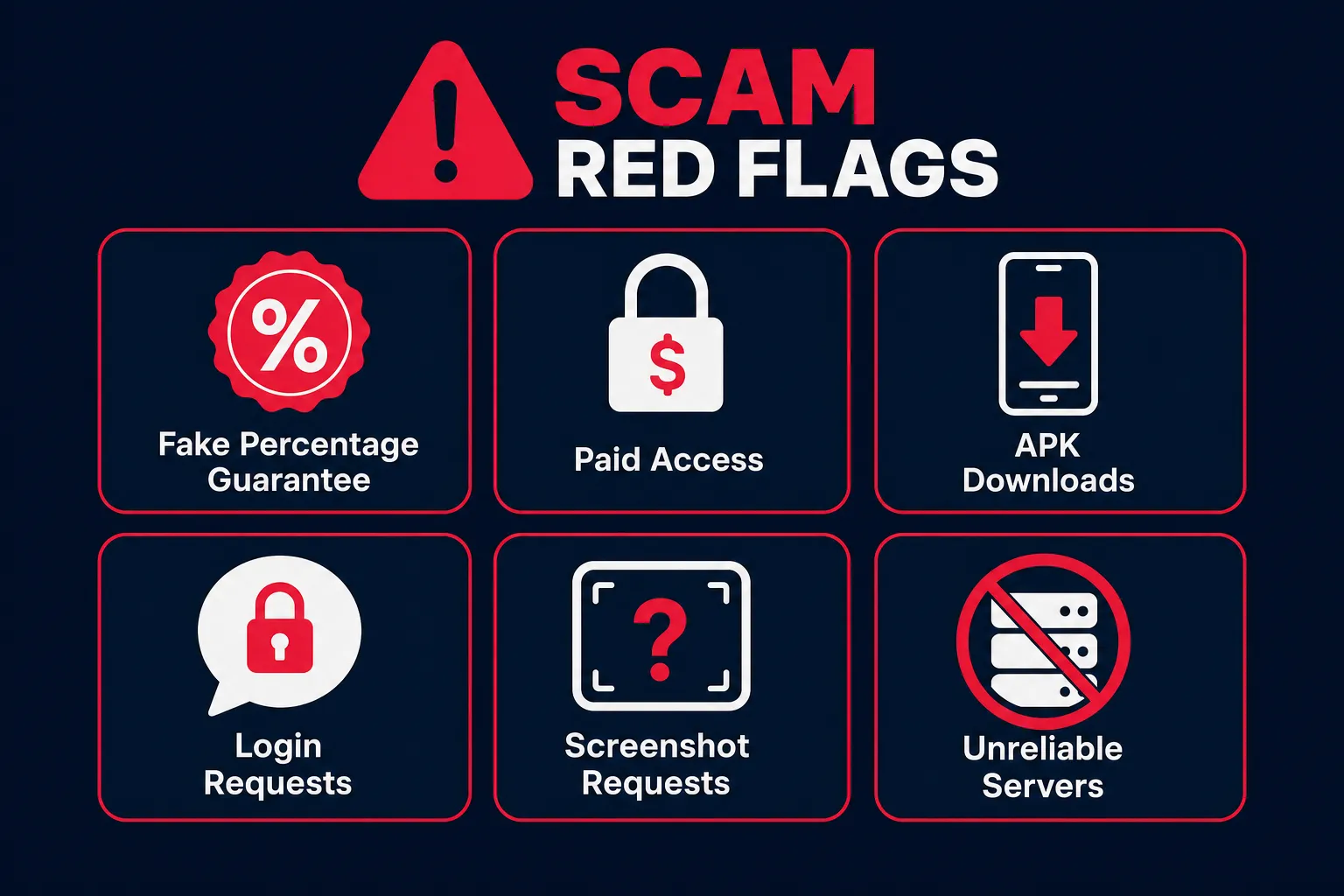
Red flags to watch for:
- A promise of an exact multiplier before the round, or a “95% accuracy guarantee.”
- A request for payment to get access, “activate,” or “unlock the algorithm.”
- Installing an APK file from a messaging app, forum, or a link in the comments.
- Being asked to enter your gaming account login and password into a third-party app.
- Screenshots of wins with no round IDs and no way to verify them.
- Promises of a “connection to the server” or “access to the RNG.”
Keep it simple: only play on the official domain or official app of a licensed operator. The risk isn’t just financial — when you register, you upload documents for FICA verification and link payment details, and in a scammer’s hands, that data is worth more than your deposit. If you want a deeper look at whether predictor tools have any legitimacy, our review of whether Aviator Predictor is real or fake covers this in detail.
Is Aviator legal in South Africa?
This is the second layer of the “is Aviator legit” question, and right now there’s no single clear public answer — the regulator, the courts and the industry don’t all agree. What follows sets out the different positions; it isn’t legal advice.
What the National Gambling Act says
Section 11 of the National Gambling Act 7 of 2004 provides that no one may engage in or make available interactive games unless permitted by this Act or other national legislation. This creates a basic split: betting with a licensed bookmaker is regulated by provincial authorities, while interactive casino-style games haven’t yet received their own regulatory framework.
The SCA’s ruling in the Portapa case and the dispute between the regulator and the industry
On 21 October 2025, the Supreme Court of Appeal ruled in Portapa (Pty) Ltd t/a Supabets and Others v Casino Association of South Africa [2025] ZASCA 158, a case about interpreting the term “sporting event” under section 55 of the Gauteng Gambling Act 4 of 1995. The court agreed that roulette isn’t a sporting event, and found it unlawful for bookmakers to offer fixed-odds bets on casino-style games. The final order was framed specifically in terms of Gauteng’s legislation — meaning the ruling covers roulette under Gauteng law, not Aviator directly.
From there, opinions diverge:
- The NGB reads the ruling broadly and maintains that online casino-style games are unlawful in South Africa until separate legislation is passed. The regulator repeated this position in its 2024/25 annual report, noting a rise in bookmakers offering interactive products “disguised” as event betting.
- The industry disagrees. SABA has stated that the SCA ruling doesn’t establish or imply a ban on licensed South African bookmakers offering bets on roulette or other casino-style games. Provincial licensing authorities, for their part, continue to allow these products, treating them as bets on a game’s outcome under a bookmaker’s licence.
- Where things stand today. As of mid-2026, the regulatory dispute remains unresolved, and operators in different provinces are effectively working under different rules for the same product. According to South Africa’s acting NGB head, speaking to Parliament in June 2026, a national policy on interactive gambling still hasn’t been formulated.
The Remote Gambling Bill: what could change
The Remote Gambling Bill (B11-2024) — introduced to Parliament in April 2024 — proposes a single national licensing regime for all forms of remote gambling, including casino-style games, administered by the NGB with oversight at provincial level. Public consultations and committee hearings have already taken place, but the bill hasn’t yet become law, and industry lawyers see 2027 as a realistic earliest date for implementation. Current status is published on Parliament’s website and in NGB materials.
What this means for you
- You must be 18 or older to play.
- Choose an operator with an active provincial South African licence, and check them against the Verified Operators list on the NGB site — this is also your only real channel for lodging a complaint.
- Offshore sites without a South African licence fall outside local oversight — if a payout is refused, you’ll have effectively nowhere to turn.
- Be ready for FICA verification — mandatory at licensed operators, though the exact timing and documents required depend on the operator.
- The availability of specific games and lobbies may change while the regulatory dispute continues. Whether or not Aviator is available at a given platform right now isn’t a measure of that platform’s fairness.
Safe platform versus risky one: 7 checks before you deposit
- Licence. The number and issuing authority are shown in the footer, and the operator appears on the Verified Operators list at ngb.org.za.
- Provably Fair panel. It’s present in the game, it opens properly, and it reveals seeds after each round.
- The stated RTP is visible in the game’s info panel, not just in marketing material.
- A demo mode or transparent bet limits visible before you register.
- Aviator’s rules and per-bet payout ceiling are spelled out in the operator’s T&Cs — find this before you deposit, not after a big win.
- App source — the operator’s official domain only; never install an APK from a messaging app or file-sharing site.
- Responsible gambling tools: deposit and session limits, time-outs, and self-exclusion.
We’ve deliberately left out specific limit, minimum stake and deposit figures here — they vary by operator and change regularly. Check the cashier and rules of the specific platform you’re using for current numbers. If you’re comparing where to withdraw your winnings, our guide on how to withdraw Aviator winnings walks through the process step by step.
Aviator, JetX and Spaceman: what’s actually worth comparing
What matters isn’t “fairness in general” — it’s specific, comparable factors.
| What to compare | What this looks like in practice |
|---|---|
| Fairness verification mechanism | Aviator uses provably fair, with revealed seeds and per-round verification. Crash games from other providers (such as JetX by SmartSoft Gaming or Spaceman by Pragmatic Play) implement this differently: some offer round verification, others rely only on a certified RNG without the ability to check an individual round yourself |
| Stated RTP | Aviator states 97%. For other games, check the figure in your operator’s info panel — even a 1–2 percentage point difference noticeably changes your expected losses over time |
| Payout ceiling and bet limits | These depend on the operator and are set out in their rules, not in the game itself |
| Platform licence | Determines whether you have any real recourse if something goes wrong — this matters more than which game you pick |
The real difference between popular crash games isn’t “fairness” — it’s the stated RTP, whether round verification exists, and the licence held by the platform you’re playing on.
Responsible gambling: limits, self-exclusion and support
Aviator is a high-volatility game, not a source of income. Being able to verify a round only protects you against a rigged result — it does nothing to protect you against losses. Short, fast rounds carry extra risk: the quicker the pace, the more bets you place per session, and the harder it becomes to stop.
- Age restriction: 18+ only.
- Set deposit and session limits in your account settings before you start playing, not after a loss.
- Use time-outs and self-exclusion — in South Africa, the minimum self-exclusion period is 6 months.
- Never chase losses or increase your stake to “win it back” — the round’s multiplier doesn’t know your past losses, and the regulator treats playing until funds run out as a sign of problem gambling.
- Free, confidential help is available: the National Responsible Gambling Programme, on 0800 006 008, or WhatsApp/SMS “HELP” to 076 675 0710.
For more practical tools and habits to keep your play in check, see our guide on responsible Aviator gambling.
Frequently asked questions
Is Aviator rigged?
There’s no evidence that round results change after they start: the multiplier is generated before the round, and the provably fair system lets you verify this yourself. That said, the game has a built-in 3% house edge, so losing over the long run is expected even when everything works exactly as it should.
Can the casino see my bet and crash the plane right on it?
Bets in a round are visible publicly — Aviator has a Live Bets list. But the multiplier is generated before bets are even accepted, and the server seed hash is published in advance: your bet size, the number of players, and their cashouts play no part in the calculation.
Can Aviator be hacked, or the crash predicted?
No. A hash can’t be reversed, the server seed isn’t revealed until the round ends, and client seeds don’t exist until players actually join the round.
Do predictor apps actually work?
No. They have no access to the server seed, so they can’t know the result in advance. Paid predictors and “signal” channels are money-taking schemes, and modified APKs put your account credentials at risk on top of that.
Is the RTP the same across all South African sites?
The official SPRIBE product is publicly stated to run at a uniform 97% RTP, and there are no confirmed operator configurations with a different figure. What can differ between platforms are bet limits and per-bet payout ceilings. You can check the stated figure in the game’s info panel in a few seconds.
Why am I losing 10 rounds in a row?
Because it’s a statistically expected event. At a 5x target, ten losses in a row happen roughly once in nine attempts; at 10x, roughly once in three.
Does auto cashout improve my odds?
No. It removes reaction time and lag from the equation, but it doesn’t change the RTP or increase your odds of reaching a target multiplier.
Is Aviator legal in South Africa?
There’s no clear public answer right now. Following the SCA ruling on 21 October 2025, the NGB maintains that online casino games are unlawful until new legislation is passed, while SABA and some lawyers point out that the ruling concerned Gauteng’s legislation specifically and doesn’t ban licensed bookmakers from offering such products. Only play with an operator that holds an active provincial licence, and check them against the Verified Operators list on the NGB’s site.
Does the demo version work the same as real-money play?
The demo reproduces Aviator’s rules and features, but there’s no public confirmation that demo and real-money play use an identical results feed and the same operator limits. Demo results carry no monetary value and don’t predict how you’ll do with real bets. Whether a demo mode is offered at all is up to the operator.
What’s the maximum possible win?
The payout ceiling per bet is set by the operator and spelled out in their rules — there’s no single figure across all platforms. Find this in the T&Cs before placing a large bet.
How do I verify a round myself?
Open the round history or the My Bets section, tap the verify icon, copy the server seed, client seeds and published hash, recalculate the hash using a public SHA calculator, and compare the values. Full step-by-step instructions are in the round verification section above.
Sources, methodology and update date
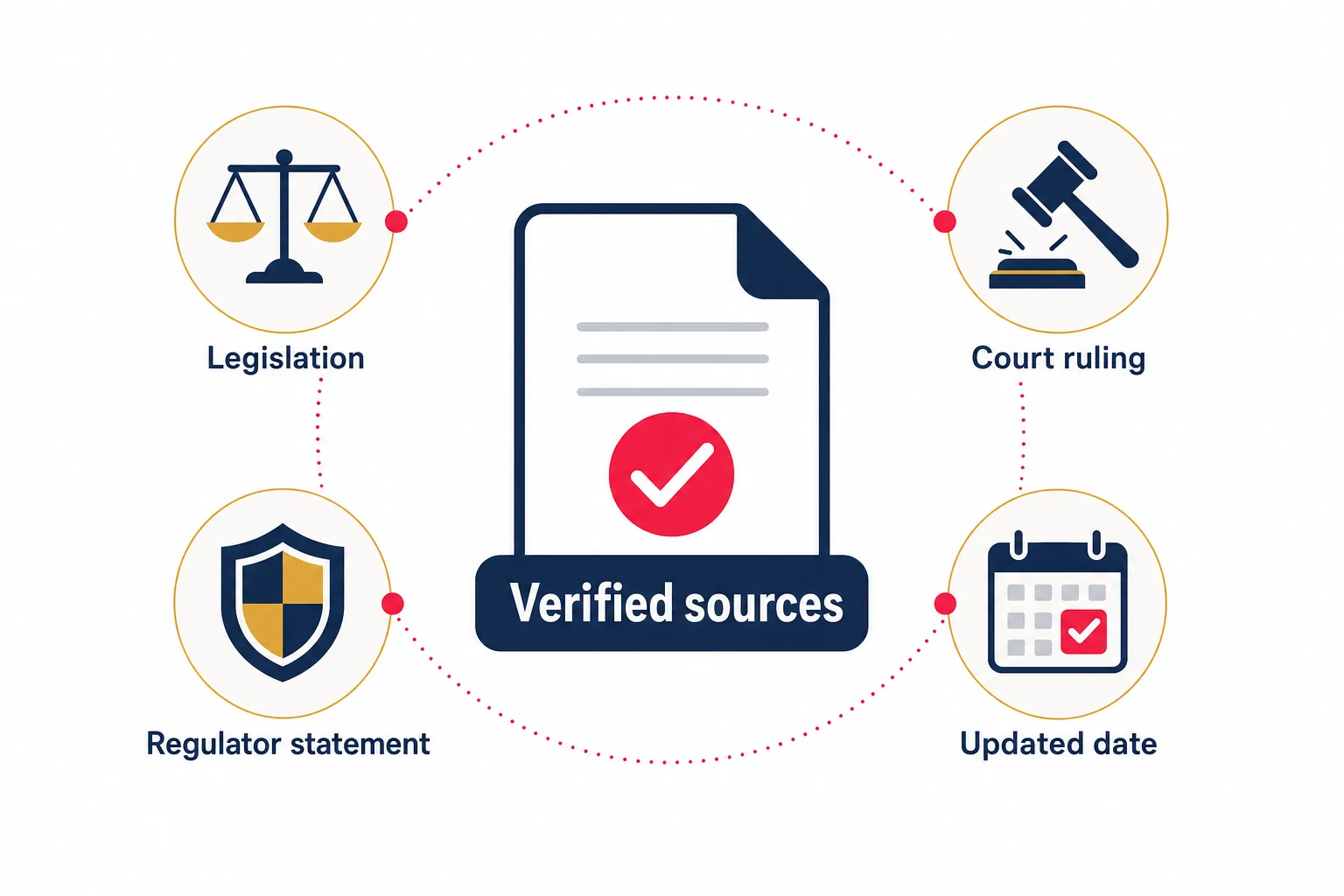
Last updated: 30 August 2026. This article was prepared by our editorial team based on the primary sources listed below.
Methodology: we relied on official descriptions of Aviator’s mechanics and the in-game Provably Fair panel, the text of the National Gambling Act, the published court ruling, and public statements from the regulator and industry association. Probability and expected-loss calculations are based on the stated 97% RTP and are presented as reference points from an idealised model.
Sources:
- SPRIBE: official Aviator page, game rules and the in-game Provably Fair panel (the primary source for verification mechanics).
- SPRIBE: licences and certificates section, including the Certificate of Suitability for South Africa.
- National Gambling Act 7 of 2004, section 11.
- Portapa (Pty) Ltd t/a Supabets and Others v Casino Association of South Africa, [2025] ZASCA 158, ruling of 21 October 2025.
- National Gambling Board: public statements, 2024/25 annual report, Verified Operators section at ngb.org.za.
- Public statements from the South African Bookmakers’ Association.
- Remote Gambling Bill (B11-2024), materials from the South African Parliament.
- National Responsible Gambling Programme, helpline 0800 006 008.
Some details depend on your specific operator and should be checked before you play: minimum and maximum bets, the per-bet payout ceiling, withdrawal limits and timeframes, bonus terms and whether Aviator counts toward wagering, and whether a demo mode is available. The legal status of online games in South Africa remains under dispute — check the NGB’s latest publications for current developments.