
Aviator Signals, Telegram Signals and Bots: Are They Real, How Do They Work, Do They Actually Help and Can They Predict Game Results?
This article breaks down what “signals” for Aviator actually are — the Telegram channels, bots and predictor apps — how their mechanics and monetisation work, and whether any outside service can genuinely know a round’s crash point in advance. It also includes practical steps for players in South Africa: how to test any channel without spending a single rand, how to spot a scam service, and where to turn if money has already been paid or an app has already been installed. Information verified as of 28 August 2026.
Quick answer: can signals predict an Aviator round
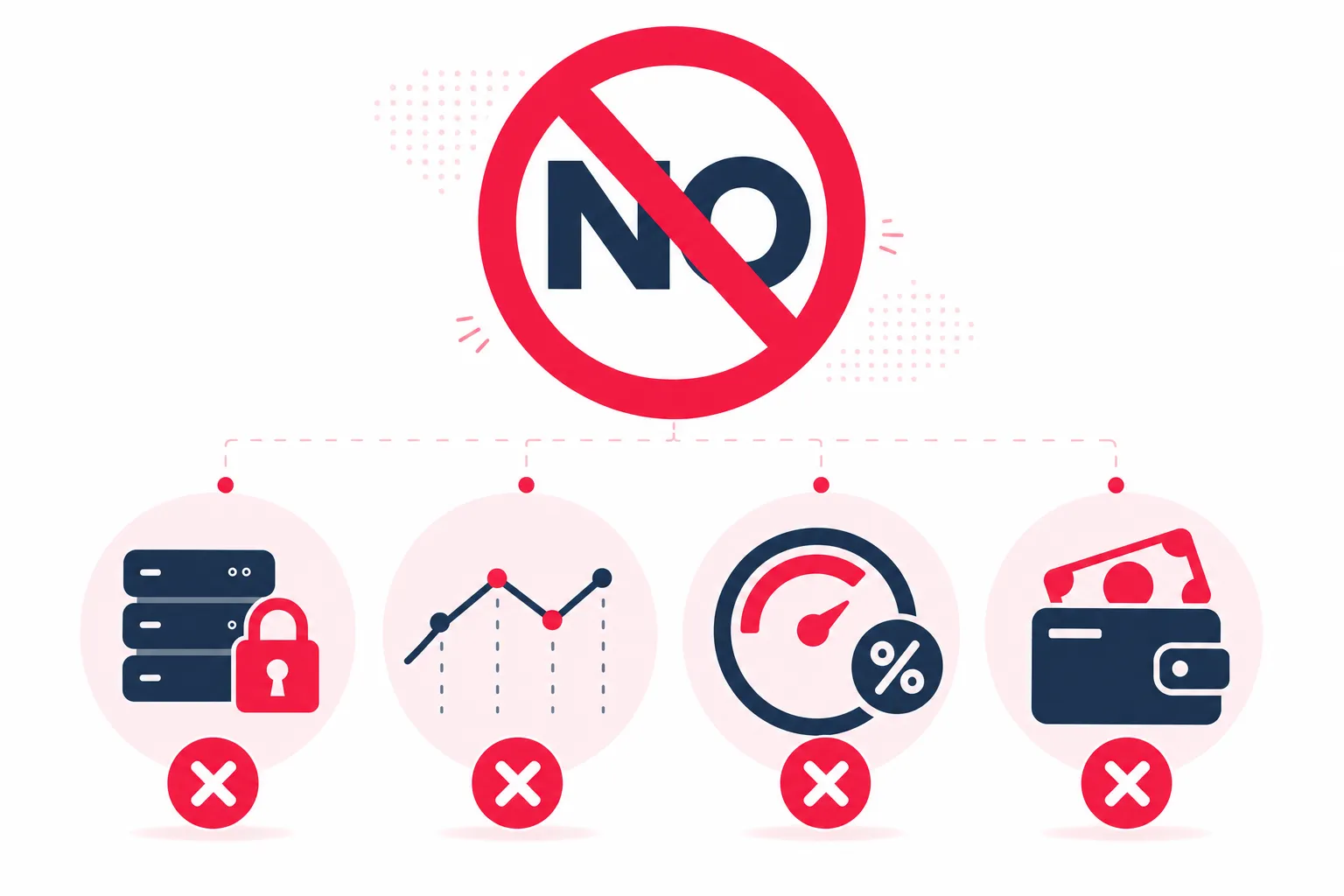
- No. No Telegram channel, bot, predictor app or “AI service” can know the crash point of the next Aviator round.
- The reason is technical: the multiplier at which the plane flies away is generated on the provider’s server before the round starts and is calculated using a server seed that no third-party app has access to.
- The result does not depend on bet size, the number of players, or when other participants hit Cash Out.
- Rounds are independent of one another, so “streaks of low multipliers” and “volatile periods” — the basis for most signals — carry no predictive value whatsoever.
- The illusion of accuracy is created through selective tactics: failed predictions get deleted, broad targets like 1.50x hit purely on base probability, and a “92% confidence” figure is never backed by anything verifiable.
- These services don’t earn money based on whether a subscriber wins — their income comes from subscriptions, affiliate links requiring a deposit, and personal data collection.
- Below is a free protocol for testing any signal channel over 30 rounds in demo mode — it lets you get the answer yourself, with no deposit and no subscription fee.
What are Aviator signals, bots and predictors: the different formats

Under the general label “signals” hide several formats that look different but all work the same way underneath.
Telegram channels and groups with signals. The most common format. Messages are posted with a target multiplier and a “confidence” percentage, sometimes with a countdown to the round. Part of the channel is free, and the rest is sold as VIP access.
Telegram bots with “access via registration”. The bot asks for your details, requires you to sign up with a specific operator through its own link, and then hands over a login and password for the “predictor”. Based on typical schemes described online, the credentials handed over often turn out not to work, while the data collected stays with the service owner.
WhatsApp groups and Discord servers. The same content, moved into messaging apps with more direct personal contact and pressure from admins.
APK predictor apps. Distributed outside official app stores, promising to “crack the algorithm” or “see the result before the round”. Often have a free version with a paid upgrade.
Web dashboards. Websites showing a feed of recent multipliers and “probabilities” for the next round, styled to look like an analytics panel.
“AI predictors”. A variation of the above formats with machine-learning terminology added. The algorithm may genuinely analyse past results, but that doesn’t translate into knowledge of the next round.
YouTube and TikTok video channels. These don’t hand out signals directly — they act as a funnel. A video with “proof” leads to a Telegram group or an APK download page.
All formats rest on the same idea: look at the history of past multipliers, label what’s happening a “low streak”, “high streak” or “volatile period”, and use that to suggest a cash-out point.
A typical signal message looks like this: the time of the upcoming round, a target multiplier (say, 2.30x), a confidence percentage, and a call to place your bet before it’s too late. None of these elements are based on data an ordinary player doesn’t already have access to.
This article deliberately avoids naming specific channels, bots or apps, or linking to them — any mention would effectively be free advertising for them.
How the outcome of an Aviator round is technically determined
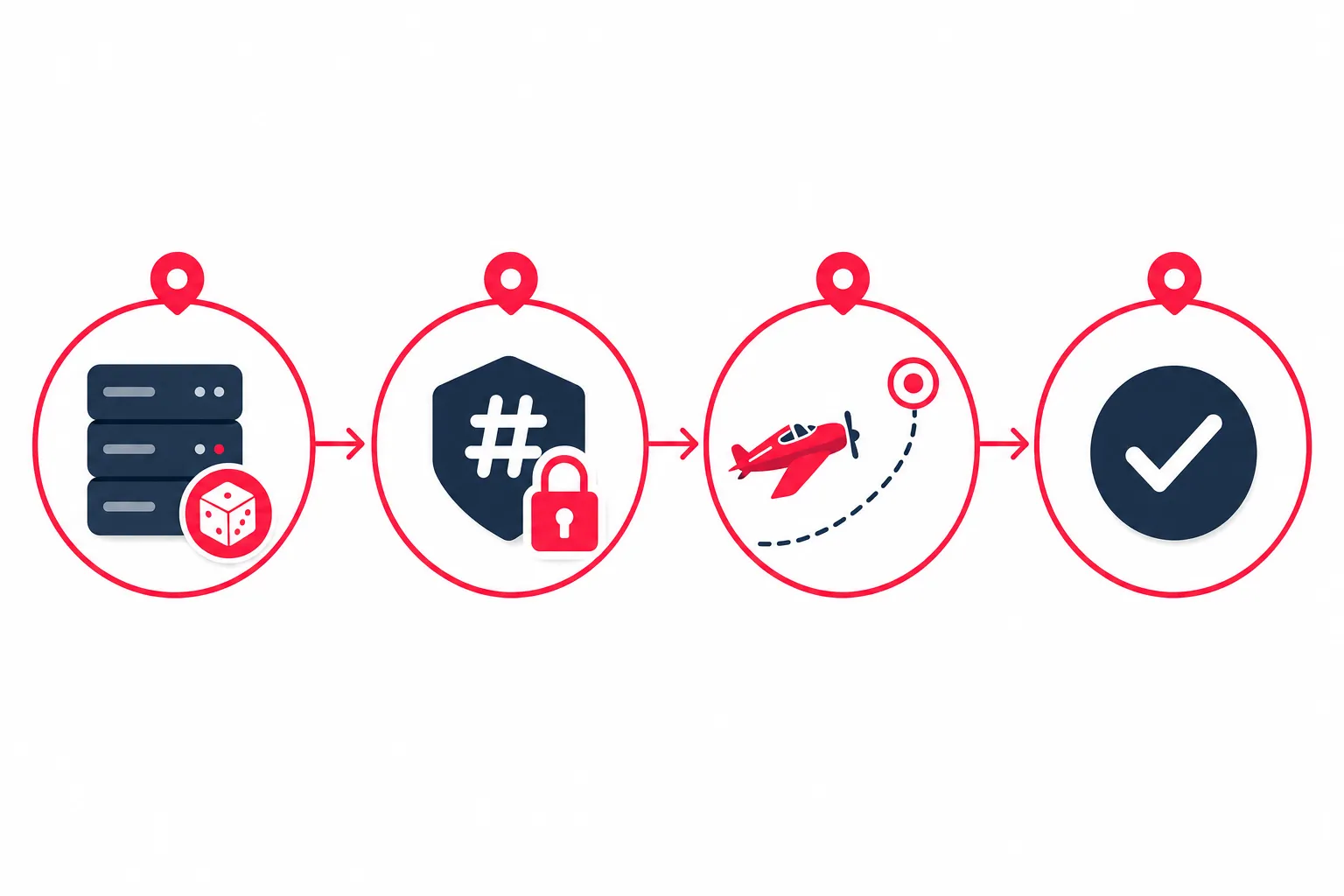
Aviator is a crash game by studio SPRIBE, launched in 2019. The game runs on Provably Fair mechanics: the result of each round is set in advance and can be verified after it ends.
Before a round starts, the provider’s random number generator on the server side determines the multiplier at which the plane will fly away. At the same time, a cryptographic hash of the server seed is published — a checksum of the original value that lets you confirm afterwards that it wasn’t tampered with. The calculation involves the server seed along with client seeds submitted by players. The server seed itself is only revealed once the round has ended.
This leads to the key point: the unrevealed server seed exists only on the provider’s servers. An external app, Telegram bot or web dashboard has no access to this value, meaning it cannot calculate the crash point. All a third-party service can see is the same history of past multipliers the player already sees in the game interface.
The second technical fact is just as important: every crash point is determined independently of previous rounds. A sequence of ten multipliers below 2x doesn’t increase or decrease the odds of a high multiplier on the eleventh round. There’s no pattern that lets anyone predict the moment of a crash, and “streak analysis” — the main argument behind signal channels — has no mathematical basis whatsoever.
Player actions don’t affect the result either: neither bet size, nor the number of players in a round, nor the moment other players hit Cash Out changes the generated multiplier.
It’s worth flagging the flip side too: the same mechanism that makes prediction impossible is what makes the game verifiable. The conclusion “if signals don’t work, the game itself must be rigged” is wrong — every completed round’s fairness can be checked personally by the player. For a broader look at how the game itself works before diving into signal claims, see our guide on how to play Aviator.
Why a 97% RTP doesn’t help predict a round
Aviator’s stated RTP is 97%, meaning the house edge is roughly 3%. This is a long-term statistical figure based on a huge number of rounds. Over a short session, the deviation from it can be very wide — that’s the nature of high-variance games. You can view the stated figure in the game’s info window, opened via the “?” icon in the interface.
The key takeaway: no cash-out strategy changes the house edge. Cashing out early at 1.20x and waiting for 10x both give exactly the same mathematical expectation — around −3% of your stake. Only the risk profile changes: a low target means more frequent, smaller wins; a high target means rare, bigger ones. So a service promising to “boost your odds” by suggesting a cash-out point is promising something the game’s mathematics simply doesn’t allow.
How a player can verify the fairness of a specific round themselves
Verification is built into the game itself and doesn’t require any outside tools.
- Open the round history or your own bets section (My Bets) in the Aviator interface.
- Select the round you want and run the Provably Fair verification function — it displays the server seed hash, the client seeds of participants, and the final result.
- Compare the hash published before the round with the server seed revealed afterwards: a match confirms the original value wasn’t tampered with.
You can check any completed round, including a lost one, as long as it’s still available in the history. How far back the history goes depends on the operator.
How signal services create the illusion of accuracy
If signals don’t work, where do the “successful” examples come from? From a set of tactics, every one of which can be reproduced without any knowledge of what’s about to happen in a round.
Cherry-picking surviving predictions. The service posts random predictions, then keeps the ones that hit while deleting or hiding the ones that miss. The feed looks like a track record of success, even though the hit rate is no different from random chance.
Rotating the audience. A channel with a few hundred subscribers sends everyone the same prediction. Those who happen to get lucky post screenshots and reinforce everyone else’s trust. Those who lose quietly leave and get replaced by new subscribers. The channel always looks “like it’s working” precisely because the audience keeps refreshing.
Broad, convenient targets. A signal for 1.50x or a phrase like “2.00x and above” gets hit due to the game’s own base probability, not because of any real knowledge. Comparing the stated accuracy against base probability exposes these claims mathematically — see the table in the next section.
A fake confidence metric. “Confidence 92%” looks like the output of a calculation, but it isn’t based on verifiable data and comes with no explained methodology.
Retroactive editing. A prediction gets posted or edited after the round has already ended. In messaging apps, an edited message isn’t always obvious to the subscriber, and a screenshot “predicting” the result can be faked in under a minute.
Win screenshots as “proof”. A screenshot proves nothing: it can be reproduced in demo mode with a virtual balance, or simply put together in an image editor.
Splitting signals into “free” and VIP. A few free predictions get shown first, framed as successes, then access closes and payment is demanded. The mechanics stay identical either way: the paid tier doesn’t give access to server data that the free version didn’t already lack.
What signal services actually earn from
There are three main monetisation models, and none of them depend on whether the subscriber actually wins or loses. This explains why the service owner has no real incentive to be accurate.
Subscriptions and one-off payments. VIP access is sold monthly. Communication happens through anonymous accounts, and payment is often requested in crypto or to a personal wallet, which makes refunds and tracing the recipient practically impossible.
Affiliate links. A common script: a message appears in the group saying signals are about to start, but access requires registering with one of the listed operators strictly through the provided link and depositing at least a set amount. The channel owner earns a commission for every referred player, regardless of how their bets turn out.
Collecting and reselling personal data. “Free” predictors often request access to contacts, camera, location, and sometimes SMS. Such an app may install spyware, redirect to fake casino login pages, or pass your data on to data brokers. The free model exists to harvest data, not to predict anything.
There’s also a straightforward logical argument against the whole “algorithm hacker” idea: if someone had genuinely gained access to the mechanism that determines crash points, they’d be extraordinarily rich, likely facing criminal charges, and would hardly be selling access for a few dollars in a chat app. The rational move in that situation is to keep the exploit secret, not advertise it.
How to test any signal channel yourself in 30 rounds without spending a single rand

This protocol turns the question of “who to trust” into something you can actually measure. It takes about an hour, requires no deposit, no subscription payment and no app installation, and works for any channel, bot or predictor.
- Open Aviator in demo mode wherever it’s available: the developer’s official site has a demo, and several operators also offer one directly. The demo reproduces the game’s rules and features with a virtual balance; limits and layout may vary by operator. That’s enough to test a channel’s claims.
- Subscribe to the channel’s free section, or get the bot’s free signals. No payment is made at this stage.
- Set up a log using the template below — in a notebook or spreadsheet.
- Record every incoming signal before the round starts: the time, the stated target, and the stated confidence percentage.
- Once the round ends, record the actual multiplier and note whether the target was hit or not.
- Collect at least 30 entries.
- Compare the actual hit rate against the base probability of the stated targets, using the table below.
Four rules against fooling yourself
- Record every signal in order, including ones you missed, ones that were inconvenient, and ones that obviously failed. Selective recording just reproduces the same cherry-picking tactic the channel itself uses.
- The signal is logged before the round, never after.
- The success criterion is fixed in advance: the round either hit the stated multiplier or it didn’t. “Almost got there” doesn’t count.
- Minimum 30 rounds. A run of 5–10 rounds shows nothing — at that scale, randomness can produce literally any result.
Log template
| No. | Time | Stated target | Stated “confidence” | Actual multiplier | Hit (yes/no) | Base probability of target |
|---|---|---|---|---|---|---|
| 1 | ||||||
| 2 | ||||||
| … | ||||||
| 30 |
Table of base probabilities for hitting a multiplier
Values are calculated using the model P ≈ 97 / M, where M is the target multiplier, expressed as a percentage. This is an estimate, not an officially published provider table — but it’s precise enough to hold channel claims up against.
| Stated signal target | Base probability of hitting it | What this means in practice |
|---|---|---|
| 1.50x | ≈ 64.7% | Hit almost two times out of three, with zero knowledge required |
| 2.00x | ≈ 48.5% | Roughly the same odds as a coin flip |
| 2.30x | ≈ 42.2% | A typical “target” used in signal messages |
| 3.00x | ≈ 32.3% | About one round in three |
| 5.00x | ≈ 19.4% | About one round in five |
| 10.00x | ≈ 9.7% | About one round in ten |
How to read the result. If a channel’s hit rate over 30 rounds is close to the base probability of its stated targets, the signal offers nothing beyond random guessing — it’s just naming what happens naturally at a known frequency anyway. A claimed “92% accuracy” for a 2.30x target, whose base probability sits around 42%, is disproven by this comparison alone, without needing to take anyone’s word for it.
A second layer of verification. It’s worth checking one or two entries from your log using the built-in Provably Fair verification described above. This confirms the result was set before the round started, meaning it couldn’t have been known to any external service.
Closing rule. If a channel or bot demands a deposit or subscription payment before it starts sending signals, the free test simply can’t be run. That condition alone is the answer: a service that’s confident in its accuracy has no reason to hide it behind a paywall.
Two limits on this protocol: it tests a channel’s claims rather than boosting your odds in the actual game, and it doesn’t involve real bets, real payments, or handing over your gaming account login. If you want to see how genuine prediction claims hold up under scrutiny, you can also read our independent breakdown of whether an Aviator predictor is real or fake.
Real risks: what a player loses beyond the subscription cost
The cost of falling for a signal service is nowhere near always limited to the subscription fee.
APK predictors and malware
Downloading a predictor as an APK from an unknown source carries the risk of installing malware, having your login credentials stolen, and being pushed toward unsafe deposits. A telltale sign during installation: requests for permissions unrelated to the app’s stated function — access to SMS, contact lists, or the right to overlay other apps.
Why you rarely find these apps on official stores: Google Play generally bans real-money gambling apps except those that are licensed and separately approved, and approved apps are required to be free to download and to block access for minors and users in unauthorised locations. On top of that, the store explicitly bans apps that mislead users, contain malware, or abuse network, device or personal data access. An app’s absence from official stores isn’t “beating censorship” — it’s a sign it doesn’t meet the rules. If you’re considering trying a predictor tool for various operators like 1win, MSport, 1xbet, Sporty or Betika, this is exactly the kind of red flag worth checking for first.
Local context makes this risk sharper: according to Interpol’s African Cyberthreat Assessment Report 2026, in 2025 South Africa accounted for 92% of ransomware detections and 70% of business email compromise detections across the African continent.
Handing over your gaming account login
An app or bot that asks for your casino account username and password is a critical red flag. An analytical tool doesn’t need access to your account to calculate probabilities. The consequences of handing over your details: access to your balance, linked payment methods, and personal data submitted during verification.
A request for your gaming account credentials should be treated as a phishing attempt, no matter how convincingly the service is presented.
Crypto payments and no way to get your money back
Anonymous messaging apps combined with crypto payments make refunds and identifying the recipient practically impossible. A bank chargeback doesn’t apply in this kind of setup, and contacting the payment provider gets you nowhere either, since the transaction was initiated by the payer themselves.
Personal data
“Free” predictors often exist specifically to harvest data: phone numbers, contact lists, location, and sometimes SMS content. In South Africa, the handling of personal information is governed by the Protection of Personal Information Act (POPIA), with the Information Regulator as the oversight body. Services distributed anonymously through messaging apps have no real obligations toward users, and holding them accountable for a data leak is practically impossible.
Indirect damage: betting on someone else’s call
Signals push players toward betting on an outside instruction rather than a plan set out in advance for themselves. This links directly to chasing losses — trying to win back what’s already gone. The NGB lists the drive to keep playing until funds run out in an attempt to recover losses as a sign of problem gambling, and according to the NGB’s 2024/25 annual report, the prevalence of problem gambling among participants has risen to 31%, up from under 6% in 2017. That’s why the responsible gambling section at the end of this article is meant to be practical, not just a formality.
Checklist: 10 signs of a scam signal service
Even a single item on this list is reason enough to walk away.
- Promises of a “guaranteed”, “100% accurate”, “secret” result, or an “official hack” of the game.
- A requirement to register with an operator strictly through the link provided.
- A requirement to make a deposit before signals start being sent.
- A request for your gaming account login or password.
- Payment accepted only in crypto or to a personal wallet or phone number.
- An app only available as an APK outside official app stores.
- Requests for permissions unrelated to the function: SMS, contacts, overlay over other apps.
- No full public history of signals, including misses — only wins get published.
- Urgency pressure: “only three spots left”, “signal in ten minutes”, countdown timers.
- No explanation of the method’s limitations. A genuine analytical tool would openly describe its limits, wouldn’t promise guaranteed profit, wouldn’t ask for a login, and wouldn’t tell you to ignore the risk.
What to do if you’re in South Africa and you’ve already paid or installed the app
There’s no automatic refund process in South Africa, so how fast you react matters.
First 60 minutes
- Call your bank’s 24-hour fraud line and request that your card or account be blocked, and ask them to attempt to stop the payment.
- Change the passwords for your gaming account, email, and any payment services used on the same device. If credentials were already entered into a third-party app, change that password immediately.
- Delete the installed APK and check what permissions it had, including whether it has active overlay access over other apps.
- Check your transaction history and session activity on your gaming account.
Within 24 hours
- File a report at any SAPS station and get a case number (CAS). A report filed the same day gives the best chance of the case being followed up. Emergency number: 10111; crime reporting line: 08600 10111.
- Report the fraud or identity theft to the Southern African Fraud Prevention Service (SAFPS) if any personal or payment details were handed over.
If the bank refuses or the service ignores you
- An unresolved dispute with your bank can be taken free of charge to the National Financial Ombud on 0860 800 900.
- Suspicious or unlawful gambling activity can be reported to the National Gambling Board on 010 003 3475 or at [email protected].
- Keep in mind the limits here: a complaint about an offshore site with no South African licence can’t be escalated to a provincial gambling board. That’s exactly why checking an operator’s licence before depositing is far more practical than trying to fix things afterwards.
How to keep evidence
- Save screenshots of conversations and signal messages, the payment details you sent money to, transaction confirmations, the name of the channel or bot, and the link where registration was suggested. The CAS number issued by SAPS will be needed for every follow-up contact — with the bank, the ombud, and regulatory bodies.
Information in this section is for reference only and does not constitute legal advice; contacting the bodies listed above does not guarantee a refund.
South Africa’s legal and regulatory context: why it matters for signals
The regulatory picture is directly relevant here, since signal channels drive traffic through affiliate links — including to operators without a South African licence.
As of August 2026, online casino games are not locally licensed in South Africa. Section 11 of the National Gambling Act 7 of 2004 prohibits engaging in, or offering, interactive games without authorisation granted under the Act itself; the exception is online sports betting through a licensed bookmaker.
The Remote Gambling Bill (B11-2024), tabled by the Democratic Alliance in April 2024 and proposing a single national licensing system for all forms of remote gambling administered by the NGB, has not been passed. Public comment has closed, parliamentary progress is slow, and industry lawyers place realistic implementation at 2027 or later.
Additional uncertainty stems from a regulatory dispute over offering casino games through betting platforms: following the Portapa ruling, the NGB issued cease-and-desist notices to provincial licensing bodies over this practice, while the industry association is contesting that position. As of mid-2026, the dispute remains unresolved, and operators in different provinces are effectively operating under different rules for the same product.
On the question of liability, the National Gambling Act’s penalty provisions target operators, not players — there are no recorded cases of individuals being prosecuted for playing at an online casino, and enforcement is focused on unlicensed operators. This reflects industry commentary, not a formal legal opinion.
How to check if an operator is licensed in South Africa
On 8 April 2026, the NGB launched an online verification portal, developed jointly with the provincial licensing authorities (PLAs). It’s a searchable register of legally licensed land-based and online operators in the country, available at ngb.org.za/verified-operators, searchable by operator name. Only operators listed on the portal are legally authorised to provide gambling services in South Africa.
The register is updated based on data from provincial bodies, so recently issued, renewed or reissued licences may appear with a delay. If an operator’s site isn’t found there, it’s more reliable to check its status directly with the relevant provincial licensing authority: some operators show up with a delay, while others simply don’t hold a South African licence at all.
An additional signal to look for: licensed bookmakers are required to display their licence number and the name of the licensing provincial gambling board on their website. The absence of these details is a red flag on its own.
What actually affects the outcome instead of signals
A fair set of expectations to start with: no approach changes the house edge. What follows is about managing risk, variance and your own behaviour — not improving your chances of profit.
- A cash-out point decided in advance. Set your cash-out target before starting the round, then use Auto Cash Out. This removes the pressure of deciding in the moment as the multiplier climbs — the main source of impulsive mistakes.
- A fixed bet size. A consistent amount, rather than increasing your stake after a loss, slows down how quickly your bankroll gets depleted.
- A loss limit and a session limit. A threshold set in advance, after which the session ends, works far more reliably than any attempt to “win it back”.
- Demo mode for practising the mechanics. The demo reproduces the game’s rules and features with a virtual balance, so it’s suitable for learning the interface, Auto Cash Out, and the dual-bet mode before moving to real money. If you’re still getting familiar with the basics, it’s worth reading our guide on how to play Aviator first.
- Dual-bet mode. You can place two bets in one round with different cash-out targets — for example, an early lock-in on one and a longer target on the second. This is a tool for managing variance; it doesn’t change the game’s mathematical expectation.
- A rand budget set in advance. It only makes sense to play with money you’ve already decided you’re prepared to lose entirely — not savings, not borrowed money, and not money set aside for essential expenses. A practical approach is a fixed monthly budget decided before the month starts.
- Limits and self-exclusion through your operator. Deposit limits are set in your account settings. Self-exclusion is arranged through the operator; the NGB states a minimum exclusion period of six months.
- Blocking gambling transactions through your bank. A number of South African banks let you block gambling-category transactions through their app or in-branch. This is an external barrier that doesn’t rely on decisions made in the moment.
Third-party sites offering to arrange “national self-exclusion” for a fee have nothing to do with the official process, and operate on the exact same logic as signal services: collecting personal data and money. These should be avoided entirely.
Comparison: paid signal service vs freely available tools
| Criterion | Signal service, bot or predictor | Freely available tools |
|---|---|---|
| Access to round data | None: the unrevealed server seed sits only with the provider | Not required |
| Verifiability of claims | A full history of signals, including misses, is usually unavailable | Provably Fair verification of any completed round, including losses |
| Cost | Subscription, often paired with a required deposit | None |
| Risk to device and data | APK outside app stores, excessive permissions, login requests | None |
| Chance of a refund | Practically none with crypto payments | Not applicable |
| Effect on the game’s mathematical expectation | None | None; only risk and variance can be managed |
| Who profits | The channel owner — from subscriptions and affiliate commissions | — |
Frequently asked questions
Are Aviator signals in Telegram real?
As a prediction tool — no. The round’s multiplier is generated on the provider’s server before the round starts, and the unrevealed server seed isn’t accessible to external apps. Channels work with the same public history of multipliers any player can see, and they monetise through subscriptions and affiliate links.
Is there a working Aviator predictor?
No confirmed working predictors exist. An app outside the game itself has no access to the data that determines a round’s result. Such APKs are distributed outside official app stores because they don’t meet store rules, and they carry the risk of malware and credential theft. For a deeper independent look at these claims, see our review of whether an Aviator predictor is real or fake.
Are paid VIP signals any different from free ones?
Technically, no. The paid tier doesn’t give access to the server seed and doesn’t change how the prediction is generated. A common scheme: a handful of free signals are framed as successful, then access closes and payment is demanded.
Can artificial intelligence predict a crash in Aviator?
An algorithm can analyse past results, but that doesn’t translate into knowledge of the next round. Every crash point is determined independently of the ones before it, so historical patterns carry no predictive power. Mentioning “AI” in a service’s description is purely a marketing move. If you’d like to see how a labelled “predictor” tool actually behaves, our Aviator Predictor page walks through it in detail.
Why do signal channels have screenshots of wins?
A screenshot proves nothing: it can be reproduced in demo mode with a virtual balance, or put together in an image editor. On top of that, when one prediction is sent to hundreds of subscribers, statistically some of them will get lucky and post “proof”, while the ones who lost simply leave without a word.
Is it safe to download an Aviator Predictor APK?
Downloading an APK from an unknown source carries the risk of malware, login theft, and spyware controlling your device. Requests for SMS, contact, or overlay permissions are a telltale sign of danger. A request for your gaming account login should be treated as phishing.
What should a player do if they’ve already paid for signals?
The first step is calling your bank’s 24-hour fraud line, then changing the passwords for accounts used on the same device, and deleting the app. Within 24 hours, file a report with SAPS and get a CAS number. A dispute with the bank can be escalated to the National Financial Ombud on 0860 800 900.
Is the Aviator game itself fair, and how can you check?
The game runs on Provably Fair mechanics: a hash of the server seed is published before the round, and the seed itself is revealed afterwards. A player can open the round history, select any completed round, including a lost one, and compare the hash against the revealed seed — this confirms the original value wasn’t tampered with.
What is Aviator’s RTP?
The stated RTP is 97%, meaning the house edge is roughly 3%. This is a long-term figure based on a large volume of bets, not the result of any single session. The figure is shown in the game’s info window, opened via the “?” icon.
Are online casino games legal in South Africa?
As of August 2026, interactive games are not locally licensed: Section 11 of the National Gambling Act 7 of 2004 prohibits offering them, or participating in them, without authorisation under the Act. The exception is online sports betting through a licensed bookmaker. The Remote Gambling Bill (B11-2024) has not been passed as of this date.
How can you check whether an operator is licensed in South Africa?
Through the NGB’s verification portal at ngb.org.za/verified-operators, searching by operator name. Only operators listed there are authorised to operate in the country. Recently issued licences may show up with a delay, so if a site isn’t in the register, it’s best to confirm its status directly with the provincial licensing authority.
Where can you get help for problem gambling in South Africa?
The National Responsible Gambling Programme’s free 24-hour line is 0800 006 008. WhatsApp support is also available: send “HELP” to 076 675 0710. Additional resources include responsiblegambling.org.za, SANCA, and SADAG.
Responsible gambling and help in South Africa
The topic of signals ties directly into loss-chasing, so knowing where to get support has real practical value.
- National Responsible Gambling Programme (NRGP): 0800 006 008 — free, confidential, 24 hours a day. WhatsApp: send “HELP” to 076 675 0710. Website: responsiblegambling.org.za.
- SARGF — a partnership between the NGB, provincial licensing authorities and the South African gambling industry; provides free, confidential counselling and treatment both for people affected by problem gambling and their loved ones.
- SANCA — support for addiction, with branches across all nine provinces.
- SADAG — support for depression, anxiety and suicidal thoughts.
- Self-exclusion is arranged through the operator; the NGB states a minimum exclusion period of six months.
- Blocking gambling transactions is available through a number of South African banks, via their app or in-branch.
Gambling is intended only for people aged 18 and older, and it is not a way to earn an income or solve financial problems.
Update date and data sources

This article was prepared and verified as of 28 August 2026.
Sources used in preparing this material include: public provider documentation and game rules, South African National Gambling Board regulations and official resources, including the operator verification portal, materials from the National Responsible Gambling Programme and SARGF, Google Play Store policies, Interpol’s African Cyberthreat Assessment Report 2026, and industry analysis on crash-game mechanics and signal-service schemes.
The table of base probabilities for hitting a multiplier is an estimate based on the model P ≈ 97 / M, not officially published provider data. No single maximum round multiplier has been publicly set by the provider, and bet and payout limits are set by the individual operator. Regulatory information is accurate as of the stated verification date and may change.
